|
 |
Automobile Equipment
|
|
| |
BRAKES
All vehicles must have both service brake and parking brake systems which can be applied separately. Parking brakes must be able to stop and hold your vehicle on any grade.
LIGHTS
The following must be in working order: headlights, taillights, license plate lights, fog taillights, brake lights, and turn signals.
Headlights: there must be two headlights at the front of your vehicles, one on each side above the front axel, between 54 inches and 22 inches from the ground. These lights must be visible in the darkness.
Taillights: there must be at least two red taillights, one on the left and one on the right rear of the car at the same level, visible from 500 ft away, and mounted between 15 inches and 72 inches from the ground. If the taillights do not provide sufficient light to read the license plate from 50 ft away, there must be a separate license plate lamp.
Fog taillights are required when fog, rain, snow, smoke, etc. hinder visibility from a distance less than 500 ft. According to California Vehicle Code §24602, these lamps should meet the following criteria:
- One or two fog lamps may be installed.
- When installing two fog lamps, they must be mounted at the left side and right sides of the vehicle at the same level and as close as possible to the sides. When one lamp is installed, it must be mounted as close as practical to the left side of the vehicle or in the center.
- The lamps must be mounted between 15 inches and 60 inches from the ground.
- The edge of the lens of the fog lamp must be no closer than four inches from the edge of the lens of any stop lamp.
- Fog lamps must be wired so they can be turned on only when the headlamps are on, and they must have a switch that allows them to be turned off when the headlamps are on.
- A non-flashing amber pilot light which indicates when the fog lamps are turned on must be mounted where readily visible to the driver.
Cars must be equipped with two or more brake lights. According to California Vehicle Code §24603, these lights must:
- Be placed between 15 inches and 72 inches from the ground. At least one brake light must be placed on the left and one on the right side at the same level at the rear of the car.
- Give off a red or yellow light and be visible from a distance of at least 300 ft away during
the day and 500 ft away at night.
- Be activated by either foot or hand control while the brakes are in use.
- Be mounted not lower than 15 inches above the roadway in the back or inside the rear window if it is a supplemental stop lamp.
- Be red.
All vehicles must have a signal system to be used by the driver to indicate when he/she wants to make a left or right turn. Under normal daylight conditions, these signal lights must be visible from the front and rear within 300 ft. "Vehicles of size" must have signal lights that are visible from 500 ft during daylight hours.
Turn signals at the front of the vehicle must emit a flashing white or amber light. Turn signals at the back of the vehicle must be red or amber. Side-mounted lights must be amber if used as a supplement to the front and rear lights. Supplemental lights may be placed on the outside rear view mirrors, provided they turn on at the same time as the front and rear headlights. They must not project a glare onto the driver.
HORN
All vehicles must have a horn or similar audible warning device that is in good working order. Your horn must not be excessively loud, but others must be able to hear it from at least 200 ft away under normal conditions.
MUFFLER
All cars must have a muffler. Mufflers receive the exhaust gas produces by the engine. They also reduce noise.
FENDERS AND MUDGUARDS
Mudguards and fenders are required on all vehicles with more than three wheels. Mounted to the rear of the tires, mudguards reduce the amount of mud or water that splashes up from the rear of the vehicle.
POLLUTION CONTROL DEVICES
Driving or abandoning a vehicle that is a "gross polluter" on a road is against the law. All vehicles must be equipped with the proper pollution control devices. Nobody may disconnect, tamper with, or change the design or performance of any such device in any way.
Summary of California Vehicle Code (§§ 26450, 26451, 24400, 24600-246003, 24950-24953, 27000-27001, 280, 425, 27150, 27600, 26700-26710, 27302-273004, 17315, 27156).
|
|
|
 |
 |
|
|
|
|
|
| |
SUSPENSION OR REVOCATION BY THE DMV
The DMV may suspend your license for six months, place you on probation for one year, or revoke your driving privilege if you incur too many negligent driver points on your record.
At the end of the suspension or revocation period, you may apply for a new license provided there are no other points on your record. In addition, you will be required to show proof of financial responsibility.
If you are convicted of hit-and-run or reckless driving which results in injury, the DMV will revoke your drivers license.
SUSPENSION BY A JUDGE
A judge may suspend your license if you are convicted of any of the following:
- Driving under the influence of alcohol or drugs
- A hit-and-run collision
- Engaging in lewd conduct and prostitution within 1,000 ft of a residence in a vehicle.
- Assaulting a driver, passenger, bicyclist, or pedestrian when the offense occurs on a highway (road rage)
- Failure to stop as required at a railway grade crossing
- Felony or misdemeanor offense by recklessly fleeing a law enforcement officer
REQUIRED REVOCATION
The DMV may revoke your drivers license if you are convicted of any of the following offenses:
- Failure to stop in a collision resulting in a death or an injury
- Using a vehicle to commit a felony
- Reckless driving causing bodily injury
- Manslaughter due to operation of a vehicle
- Involvement in three instances or more of the following: reckless driving, failure to stop at a collision scene, or failure to report damage
DRIVING WITH A SUSPENDED OR REVOKED LICENSE
All official suspension and revocation notices from the DMV are sent via certified mail. Upon receiving one of these notices, the driver must surrender his or her drivers license.
If a person is found driving with a suspended or revoked license, he or she may be punished as follows:
- For a first conviction, the punishment will be imprisonment for not less than five days or more than six months and a fine of not less than $300 or more than $1,000.
- For a second offense taking place within five years of the prior offense, you will be imprisoned for not less than 10 days or more than one year and by a fine of not less than $500 or more than $2,000.
- The vehicle may be impounded and sold.
|
|
|
|
|
|
|
|
TYPES OF VEHICLE INSURANCE |
|
|
Comprehensive Insurance
This coverage is not required by law. It covers a loss that is NOT the result of a collision. This usually includes fire, theft, falling objects, or a collision involving a deer. This type of insurance also pays for a rental car or other temporary transportation if owner's car is stolen.
It's good to have this insurance for new or expensive vehicle. Usually this insurance is required by a lien holder.
Comprehensive insurance pays for repairing or replacing owner's vehicle. It insures for the depreciated value of the vehicle. Note that you are subject to a deductible.
Collision Insurance
It covers repairs to your vehicle for damage caused by a collision, subject to a deductible, usually in a case in which no other person is at fault. This coverage is not required by law.
Note that collision insurance pays the cost of fixing or replacing the owner's car after a collision-regardless of who was driving or who was to blame. Payment is limited to actual cash value of the owner's car, minus the owner's deductible. Actual cash value is the value of a car like the owner's before it was damaged.
No-fault Insurance
This insurance provides some basic benefits and coverage for bodily injury to you and others without having to determine who is at fault in a collision. Payment provisions are made for losses from a collision caused by a hit-and-run driver or uninsured motorist.
Towing
It pays for towing charges when owner's car is disabled. Also pays labor charges, such as changing a tire, at the place where owner's car is disabled.
Some other examples where this applies are when you have a dead battery, when you have run out of gas on the road, or when you have been in a collision and need the vehicle to be towed.
|
|
|
|
|
|
|
|
OPERATOR ERROR |
|
| |
DRIVING TOO FAST:
Speeding is one of the most common causes of fatal collisions. You must always be aware of your speed when driving
because speed
affects almost everything else that can happen to you in the car.
ILLEGAL OR UNSAFE SPEED IS ONE OF THE HIGHEST CONTRIBUTING FACTORS OF COLLISIONS AND FATALITY RATES IN AMERICA (NHTSA).
FOLLOWING TOO CLOSELY:
Following too closely (also known as tailgating) causes most rear-end collisions. If you are following another vehicle too closely, you will not able to see hazards ahead of you, and you will have less time to stop or slow down. This may cause you to collide with the rear end of the vehicle ahead of you in an emergency situation.
INATTENTIVE DRIVING:
You must always pay attention to driving and road conditions. Changing CDs or radio stations and turning up the volume are simple operations, but they can be deadly especially in bad weather or heavy traffic.
POOR VISUAL AND SCANNING HABITS:
To be able to respond to potentially hazardous situations, a driver must first be able to see it. Drivers with poor visual and scanning habits are not able to avoid last minute moves or spot possible traffic hazards. This causes road collisions.
MAKING POOR DECISIONS:
Making a poor decision while driving can also result in a collision. Poor decisions can be a result of:
1. Not knowing the law.
2. Disregarding the law.
Violations of the right-of-way rules, stop signals, and signs can cause collisions. Other drivers expect you to obey the laws. When you don't, they are caught in a hazardous condition by surprise. Traffic laws and right-of-way rules help people drive safely. Ignorance is not an excuse for failing to obey these laws. If you are not aware of a traffic law and you hit someone, you will be liable for causing the collision.
CHANGING LANES IMPROPERLY:
Improper lane changes can
cause
collisions. For example, collisions can happen if you are making a lane change and you:
1. Fail to check traffic in the zone you want to enter as well as the zone alongside your new lane position.
2. Fail to check rear zones through the rear view mirror.
3. Fail to signal.
4. Fail to check your blind spots.
5. Fail to adjust speed. Normally, if you are moving into a faster (left) lane, you should expect to increase your speed slightly as you move smoothly into the next lane.
6. Fail to cancel your signal after lane change. This can confuse other drivers.
UNSAFE PASSING:
Passing requires you to move into the lane belonging to oncoming traffic to pass a vehicle ahead of you. Unsafe passing could be illegal passing (such as crossing the solid yellow line to go around a car in front of you) or passing without sufficient clearance. Unsafe passing can result in a deadly head-on collision.
FAILURETO KEEP TO THE RIGHT:
Failure to keep to the right or hogging the road can lead to aggressive and dangerous behavior. Sometimes drivers don't realize that they are driving at much slower speeds than the normal traffic flow and that they should be in the right lane or using a turn-out lane to let the driver behind them pass. Many drivers lose their patience when stuck behind a slow moving vehicle. This results in unsafe passing and lane changes.
NOT KNOWING HOW TO HANDLE SKIDS:
Not knowing how to handle your vehicle in emergency skids is a significant cause of collisions. If asked about traction loss, skidding, or problems of directional control, most drivers think of winter with wet snow or ice-covered roads. In fact, skidding is a major contributor to traffic collisions at all times of the year.
|
|
|
|
|
|
|
|
HAZARDOUS DRIVING CONDITIONS |
|
| |
INTERSECTIONS
Collisions at controlled intersections are most frequently caused by drivers disobeying stop signs and red lights or otherwise violating the right-of-way (such as turning left in front of an approaching vehicle). Some collisions happen because the driver fails to plan ahead for anticipated turn and finds him/herself in the wrong lane. Last minute moves or lane changes pose hazardous driving conditions in intersections.
You should be able to predict traffic stoppages that could cause an intersection trap. You should position your vehicle so that a traffic search 20 to 30 seconds ahead enables you to spot conditions and determine whether an intersection can be cleared when a signal light turns red. Failing to do so will result in you blocking the path of other vehicles entering intersection on green light.
Failing to stop or slow down for cross traffic or pedestrians when approaching an uncontrolled intersection can also result in collision.
POOR VISIBILITY
Driving becomes hazardous when visibility is reduced due to darkness, fog or smoke or when the road surface is covered with rain, snow, or ice.
Serious pile-up collisions involving multiple vehicles frequently occur in severe fog. Sometimes a road that is normally safe becomes dangerous when slippery. Ice and packed snow on the road can cause your vehicle to skid, especially if you are driving fast or traveling downhill.
Many new drivers do not slow to safe speeds for road conditions, which is one reason why they have more out-of-control collisions than experienced drivers.
Remember, stopping distances on slippery roads may be two to ten times greater than on dry roads. And, if there is fog or if it is raining or snowing, you will not be able to see as well as you would normally.
Be very careful when you drive at night. Drive slower as you cannot see as far.
You will have less time to stop if a hazard lies ahead. Make sure you can stop within the distance lighted by your headlights.
Don't look directly into oncoming headlights. Instead, look toward the right edge of your lane. Watch the oncoming car out of the corner of your eye.
Do not try to "get back" at the other driver by keeping your bright lights on. If you do, both of you may be blinded. Drive as far to the right as possible if a vehicle with one light comes toward you. It could be a bicycle or motorcycle, but it could also be a vehicle with a missing headlight.
ROAD VARIATIONS
Many roads involve variations like unpaved roads, sand, slick road surfaces, mountains, curves, etc. These surfaces have different traction and cause you to skid if you are not careful in controlling your speed.
Driving on hill crests and curves is dangerous as you have limited sight lines. You never know what is on the other side of a steep hill or a sharp curve. If a car is stalled on the road just over the hill or around a curve, you must be going slowly enough to stop
and avoid hitting it.
Parked cars on urban roadways also pose a driving threat if you don't pay attention. These parked cars block your view of oncoming traffic. You should drive slowly and keep a lookout for doors opening or people getting out of the car. You will be at fault if you hit a parked car or people getting out of the car on a narrow roadway.
|
|
|
|
|
|
|
|
AVOID BEING REAR-ENDED BY ANOTHER VEHICLE
|
|
| |
Rear-end collisions occur when a vehicle hits you from the back. These are common when the vehicle behind you is driving too close to your car. Avoid sudden moves and stops so that the vehicles behind you have time to react. Keep your brake pedal depressed even after stopping.
If you stop or turn unexpectedly and the car behind you hits you it could be your fault.
To avoid being rear-ended by another vehicle, you should:
- Always signal when you change direction. Signal even when you don't see any cars around. A car you don't see might hit you.
- Signal early for turns, stops or lane changes.
- Always signal before pulling next to (or away from) the curb.
- Even though you signal, do not assume that the space you wish to occupy is clear. Look in your mirrors and over your shoulder to check your blind spot before making a lane change.
You should keep rear lights clean and functioning. Check these lights at least once a week or whenever you stop for gas. Replace any burned out bulbs at once. This can be a safety issue. If your brake lights are not working, the driver behind will not be able to know if you are stopping or slowing down and might run into rear end of your car.
Collisions tend to happen when one driver is going faster or slower than other cars on the road. If you are going faster than traffic, you will have to keep passing other cars. Each time you pass another car, there is more risk of a collision. The car you are passing may change lanes suddenly. On a two-lane road, an oncoming car may appear suddenly. It may not be a big risk, but if you are passing one car after another, the risks begin to add up. Note that speeding does not save more than a few minutes in an hour's driving.
Going slower than other cars or stopping all of a sudden can be just as bad as speeding. It tends to make cars bunch up behind you and it could cause a rear-end collision. If many cars are pulling out to pass you, maybe you should increase your speed to the speed limit or move over into the right lane.
Check the traffic in both rear view and side view mirrors. Safe driving requires you to know the traffic conditions behind your car as well as to the sides. By, checking mirrors you will be able to judge following distances of other vehicles on the road and know if you are being tailgated.
|
|
|
|
|
|
|
|
GIVE YOURSELF EXTRA CUSHION
|
|
| |
- When followed by a tailgater. You should allow extra room between your car and the car ahead. Then, if you need to slow down, you can do so gradually. You will be able to avoid braking suddenly, and being hit from behind by the tailgater!
- When your vision is blocked by poor visibility on road (e.g. fog or heavy rain).
- When following large vehicles (e.g. trucks, SUVs, or buses) that block your view ahead. You need the extra room to see around the vehicle and to the sides.
- On slippery roads. If the car ahead should slow or stop, you will need more distance to stop your car.
- When it rains or snows. Stopping distances increase on snowy and wet roads.
- When following motorcycles. If the motorcycle falls, you'll have to avoid hitting the rider. Motorcycles fall more often on wet or icy roads, on metal surfaces, such as bridge gratings or railroad tracks, and on gravel.
- When the speed is increased and the traffic flow is fast, for example, on freeways. In such cases, you need a safe gap of at least five seconds.
|
|
|
|
|
|
|
|
ILLEGAL U-TURNS |
|
| |
U-turns are not allowed:
- On a divided highway by crossing a dividing section, curb, strip of land, or two sets of double yellow lines
- Where you cannot clearly see 200 ft in each direction because of a curve, hill, rain, fog, or other reason
- Where a NO U-TURN sign is posted
- When vehicles may hit you
- On a one-way street
- In front of a fire station
- In business districts (areas with churches, apartments, multiple dwelling houses, clubs, and public buildings, except schools, are considered business districts)
- Against two sets of double lines marking a center divider, except through an opening provided for turns
|
|
|
|
|
|
|
|
BACKING UP |
|
| |
Follow these rules:
- Check behind the car before you get in. Look for small objects. Children and pets are hard to see from the driver's seat.
- Pivot your heel, place the right foot on the brake, and shift to reverse.
- Grasp the steering wheel at 12 o'clock with the left hand.
- Sharp turns while backing may require use of both hands. Backing around corners or sharp curves should be avoided unless you have good visibility in all directions.
- Look over your right shoulder through the back window. That is, turn your head and body to the right until you can see clearly through the back window. To improve balance, a driver's right arm can be draped over the back of the seat. The left hand grips the steering wheel near the top and turns it in the direction a driver wants the vehicle to go.
- To steer the car in reverse, turn the wheel in the direction you want the rear of the car to go. Turning the wheel to the right steers the back of the car to the right. Turning the wheel to the left steers to the left.
- Use the brake and accelerator effectively for speed control. Always back slowly (3 - 5 mph) to avoid collisions.
- Make frequent quick checks to the front and stop at a designated line.
If the ability to turn your head and shoulders is restricted:
- Avoid backing up, if possible.
- Find parking places that do not require backing up.
- Use all your mirrors.
- In a difficult situation, ask a person outside the vehicle to give you direction.
|
|
|
|
|
|
|
|
SPECIAL PROBLEMS ASSOCIATED WITH CITY DRIVING |
|
| |
Examples of special problems associated with city traffic include:
- Parked cars blocking view of oncoming traffic; cars entering or exiting parking places; doors opening, etc.
- Delivery trucks; drivers racing to and from the trucks, stopping suddenly, etc.
- Buses; loading and unloading passengers.
- Blind alleys; cars or bicyclists darting out of alleys.
- Pedestrians; moving to and from office buildings, stores, crossing streets illegally, etc.
- Intersections spaced at shorter intervals.
- Impatient drivers competing for lane space or a parking place.
- Stop and go traffic flow.
- Detours, in case the main route is closed.
- Turning at sharp corners.
- Driving on one-way streets.
|
|
|
|
|
|
|
|
SPECIAL SITUATIONS |
|
| |
To prevent congestion and unpredictable travel times on our freeways, RAMP METERS are provided at freeway entrances. These ramp meters are timed entrance lights and will help prevent slowdowns and "stop-and go" conditions that freeway travelers frequently encounter.
Ramp meters look like the traffic signals you see at intersections, but they have only red and green lights. Ramp meters are placed on freeway on-ramps and allow only one vehicle (in some places, two vehicles) to pass each time the green light comes on. The wait isn't long because the green light comes on again in just a few seconds.
Double merge lanes allow traffic on high volume on-ramps to create gaps to allow vehicles to merge safely. This may also include carpool lanes.
Carpooling and bus riding are useful ways to save fuel and reduce the number of vehicles using highways in heavy commuter traffic. Some freeways have special lanes and on-ramps for carpools.
You may use a CARPOOL lane if your vehicle carries a minimum of 2 or 3 people, including the driver, or you drive a low-emission vehicle that displays a special decal issued by the DMV (the passenger restriction does not apply).
|
|
|
|
|
|
|
|
CHOOSING LANES |
|
| |
On a two lane freeway, you should drive in the right lane. The left lane is usually reserved for passing.
Freeways that have several lanes in each direction are multi-lane freeways. You should leave the extreme left lane for faster traffic or to pass slow moving vehicles. The right lane should be used for traffic that paces more slowly than the normal traffic flow.
Always choose a lane that has a clear view and is appropriate for your speed.
When you are driving a bus, towing a vehicle, or driving a large truck, you will usually be traveling slower than other vehicles. You must drive in the right-hand lane or in a lane specially marked for you. If no lanes are marked, and four lanes go in your direction, you may only drive in either of the two lanes closest to the right side of the road.
|
|
|
|
|
|
|
|
FREEWAY EMERGENCIES |
|
| |
If you see a hazard ahead of you or in case of an emergency, communicate with the other traffic behind you by:
- Flashing your brake lights
- Flashing your headlights
- Turning on your hazard lights
BREAKDOWN
If you car breaks down on a freeway, don't panic. To avoid suddenly stopping in traffic, follow the guidelines given below:
- Pull your vehicle to the shoulder and completely off the pavement if you can do this safely. Do not use the shoulder next to the center divider if at all possible.
- Warn others that you are having difficulties by using your hazard lights.
- Have your vehicle on the right shoulder and as far away from traffic as possible. Make sure that your vehicle is visible for at least 200 ft in either direction and vehicles have enough space to pass.
- Use flares and reflectors when parked on the shoulder to warn approaching traffic.
- Call for help and have your vehicle towed off the freeway as soon as possible. Note that if your vehicle is parked, stopped, or left standing on a freeway for more than four hours, it may be removed by law enforcement.
RE-ENTERING FREEWAY FROM THE SHOULDER
If you must enter a freeway lane from the shoulder, follow the steps given below:
- Give a signal.
- Accelerate as much as safely possible on the shoulder itself. Don't enter the lane immediately; this could mean entering into fast moving traffic, possibly causing a collision.
- Make sure there is an adequate gap between your vehicle and traffic when entering the freeway lane.
You must yield to traffic as you reenter a highway after being parked.
|
|
|
|
|
|
|
|
AREAS OF POTENTIAL HAZARDS |
|
| |
On open highways, be aware of the following hazards and driving challenges:
1. Unmarked field and farm driveways and entrances: On open highways in rural areas, you may find field and farm driveways entrances that are unmarked. These unmarked roads are hidden because of crops, bushes, or trees. Always reduce your speed as you drive in such areas.
2. Livestock crossing areas and farm vehicles: When driving in rural areas you must be wary of things such as tractors, farm trucks, and farm animals in the roadway. Always be alert and keep a lookout for any animals crossing the highway. If you encounter a herd of animals on a highway, stop and let the animals cross. Once they are gone, proceed with caution.
3. Rough road conditions: Rural highways are rough roads designed for slower speed. These roads are paved with different materials like concrete, asphalt, crushed stone etc. Fresh tar is often spread over gravel when patching the rural roadways. Proceed with care to avoid throwing tar on your vehicle and stay well back from any traffic in front to avoid flying gravel.
4. Roadside stands and gas stations: Drivers on rural highways encounter many additional hazards as the highway passes through small communities. Roadside stands, gas stations, restaurants, grocery stores, and rural attractions such as antique stores, rodeos, and local events are often found on the side of the highway.
5. Soft and unmarked shoulders: Be aware of unmarked and soft shoulders on open highways.
|
|
|
|
|
|
|
|
ROAD CONDITIONS |
|
| |
Most open highways in rural areas are maintained less frequently and lack the advanced features of modern freeways. These roads are paved with different materials like asphalt, concrete, crushed stones, tar, or gravel. In some places, these highways may not be paved at all.
Each of these surfaces has different traction, so the grip of the vehicle on the road might change. Rough roads and roads with potholes will cause your vehicle to bounce. In this case, your tires may lose traction with the road surface. Sand or gravel is often spread on roads to provide traction in icy conditions. This can have the opposite effect after the ice melts and the roads dry.
Rural highways are usually narrower; you may even encounter one-lane bridges.
When approaching a one-lane bridge, slow down. If you come upon the bridge and there is on-coming traffic closer to the bridge, yield to the other traffic. If there is ever any doubt, yield. A safe driver always practices courtesy and allows the other vehicle to proceed.
Difficult weather conditions make rural driving even more treacherous than normal highway conditions. Avoid traveling on mountain highways if you know there will be conditions of fog, snow, or ice. If you are caught in a severe thunderstorm or severe weather while traveling, proceed with the utmost caution. When visibility is severely reduced, turn on your hazard lights and locate the white lane on the right of the highway (if at all possible). Then pull to the side of the road, stop, and wait for conditions to improve.
On open highways, you need to have a clear picture of what to expect on the road ahead where you intend to travel. You must be able to direct your attention to the road, maintain an open line of sight, and scan the environment for potential hazards.
The ability to see the center of your path of travel from your vehicle to the target area is your "line of sight." This line can be blocked by a curve, the crest of a hill, a wooded area, a large truck, etc.
If you cannot see around an obstruction, you must slow down and be ready to alter your position as necessary until you can reestablish a clear line of sight to your path of travel and targeting area.
|
|
|
|
|
|
|
|
DRIVING IN SNOW AND ICE |
|
| |
Here are some guidelines for driving in snow or icy conditions:
- Keep the windows and windshield clear.
- Obtain maximum visibility by turning on low-beam headlights and windshield wipers.
- Drive more slowly and stay farther behind the vehicle ahead. Slow to a crawl on ice. Slow down as you approach curves and intersections.
- Avoid fast turns.
- Avoid quick stops.
- Shift to low gear before going down a steep hill, but do not downshift at too fast a speed.
- Use all-weather radial tires, snow tires, or chains. Even properly equipped vehicles may slide on ice or snow-packed roads.
- Avoid sudden changes in speed and direction.
- If you drive in snowy areas, carry chains in case you find yourself in conditions where you can't drive without them. Make sure you carry the correct number of chains and that they will fit your drive wheels. Learn how to put the chains on BEFORE you need to use them.
|
|
|
|
|
|
|
|
OFF ROAD RECOVERY |
|
| |
These are the steps you should follow if the front wheel drops off onto a low shoulder:
- Ease off the accelerator to slow down.
- Don't use the brakes unless you're headed for some obstacle, such as a bridge.
- Steer parallel to the road and slightly to the right to keep the tires from scraping the edge of the pavement and throwing the car back across the road.
- Continue to slow gradually to an extremely slow speed (less than 25 mph), until the vehicle is under control.
- Check for traffic approaching in the lane you will re-enter and signal.
- Gently ease the right wheels onto the pavement.
- Straighten into the first lane and speed up to the flow of traffic.
|
|
|
|
|
|
|
|
OVERHEATING |
|
| |
Most vehicles have dashboard gauges or lights that indicate the engine temperature. Activities such as driving in stop-and-go traffic on a hot day, driving on steep inclines, and towing a trailer can cause your engine to run hotter than normal.
If your temperature gauge moves up to just below the red zone, turn off your air conditioner and turn on your vehicle's heater to its highest and hottest setting to help draw some of the heat away from the engine; then immediately seek out a service station with a mechanic.
If your temperature gauge is elevated and rising, and you are stopped in traffic, briefly put the car in (p)-park and lightly step on the gas to help circulate coolant.
If the temperature light goes on or if the gauge enters the red zone, immediately pull off the road to a safe spot, well away from traffic, and stop the engine.
Wait 20 minutes, start up the engine, and if the temperature light does not come on, proceed directly to the nearest garage with a mechanic. If at any time the gauge goes back into the red zone or the temperature light comes on, pull over immediately, turn off the engine and repeat the wait process.
Never attempt to remove the radiator cap when your car is hot, and do not pour water over a hot radiator or engine. You must wait a sufficient amount of time until your engine cools.
|
|
|
|
|
|
|
|
STATISTICS |
|
| |
According to the NHTSA, there were 12,998 alcohol-impaired driving fatalities in 2007. These deaths constituted 32% of the total traffic fatalities for the year.
In 2007, there were 3,974 traffic fatalities in California. Alcohol was involved in 1,155 (29%) of the collisions.
Motor vehicle crashes are the leading cause of death for 15- to 20-year-olds. In 2007, 3,174 15- to 20-year-old drivers were killed and an additional 252,000 were injured in motor vehicle crashes. The severity of a crash increases with alcohol involvement. In 2007, 3% of the 15- to 20-year-old drivers involved in property damage-only crashes had been drinking, 4% of those involved in crashes resulting in injury had been drinking, and 23% of those involved in fatal crashes had been drinking. (NHTSA, Traffic Safety Facts, 2007)
|
|
|
|
|
|
|
|
TEENS ARE LESS LIKELY TO DRINK AND DRIVE
California and all other states now have 21-year-old minimum drinking age laws. The NHTSA estimates that the 21-year-old minimum drinking age laws have reduced traffic fatalities involving drivers 18 to 20 years old by 13% and have saved an estimated 27,052 lives since 1975. In 2008, an estimated 714 lives were saved by minimum-drinking-age laws.
TEENS MORE LIKELY TO EXHIBIT IMPAIRED DRIVING SKILL AT LOWER BLOOD ALCOHOL LEVELS
|
|
| |
According to the last NHTSA data (Traffic Safety Fact 2008) there were 205.7 million licensed drivers in the United States. Young drivers, between 15 and 20 years old, accounted for 6.4% (13.2 million) of the total.
12% (5,864) of all drivers involved in fatal collisions (50,186) were young drivers age 15 to 20 years old, and 14% (1,429,000) of all drivers involved in police-reported collisions (10,081,000) were young drivers.
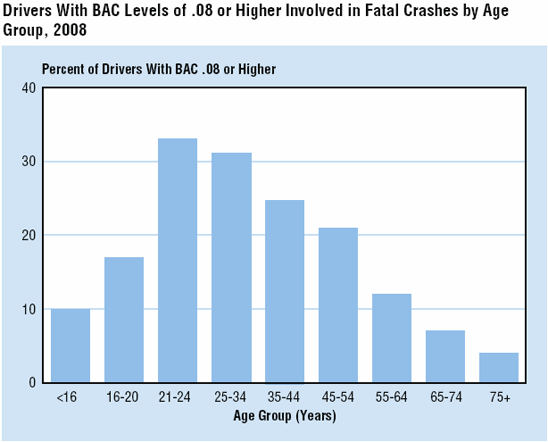
31% of the young drivers (15 to 20 years old) who were killed in collisions had a BAC of .01% or higher, 25% of them had a BAC of .08% or higher (compare to 32% of all drivers with a BAC of .08% or higher). |
|
|
|
|
|
|
|
|
|
|
|
THE PHYSIOLOGICAL RESPONSE TO ALCOHOL |
|
| |
Brain
Because the brain is supplied with more blood than other organs, alcohol impairs brain function within minutes of consumption.
Stomach/Intestines
About 5% of alcohol consumed is absorbed in the mouth and throat. The other 95% is then absorbed within the digestive system. Alcohol irritates the linings of the stomach and intestine which can lead to vomiting. It also increases blood flow to the stomach and intestines. Heavy drinking can cause bleeding in the stomach due to excess acid secretion.
Alcohol cannot be retained in your body's tissue without serious health effects.
About 2-5% of the total alcohol consumed is passed unchanged by body functions.
- Less than 10% of the total is then eliminated through the kidneys, lungs, and skin.
- The remaining 90% must be slowly eliminated by your liver through oxidation.
Liver
The liver clears poisons including alcohol from the body. This organ is vital in producing substances which fight infections, help blood clotting and health in general. It also detoxifies many substances in the blood. Alcohol may cause alcoholic hepatitis (inflammation of the liver) or cirrhosis (scarring of the liver). The liver is stressed for about two hours as it works to break down the alcohol content of just one drink. Heavy drinking over a period of years may damage the liver to the point of failing?resulting in death.
Blood
Drinking alcohol causes the red blood cells clump together causing the small blood vessels to plug up, starve the tissues of oxygen, and cause cell death.
Other effects of alcohol on the blood include: anemia; reduced red and white blood count, lowered resistance to infection; and a decrease in the ability to fight off infections.
Vision
Consuming alcohol can have short-term negative affects on vision. As the legal blood-alcohol level is reached and surpassed, depth perception and night vision are diminished.
Blurred or double vision may occur and it becomes difficult or impossible to judge distance. The headlights of an oncoming car can dazzle a drunk driver because his or her pupils are unable to adapt from dark to light. |
|
|
|
|
|
|
|
PENALTIES |
|
| |
If you do not take or fail to complete a chemical test to determine the cause of impairment, you will be subject to the to the following license penalties:
. For the 1st offense: A license suspension of 1 year.
. For the 2nd offense within a 10 year period: A license revocation for 2 years.
. For 3 or more offenses within a 10 year period: A license revocation for 3 years.
If you take a chemical test and it shows a BAC of 0.08 percent or higher or determines the presence of drugs, you will face the following minimum penalties in addition to severe criminal penalties:
. For the 1st offense: A license suspension for 4 months.
. For a 2nd or further offense within a 10 year period: A license suspension for 1 year.
|
|
|
|
|
|
|
|
DRUG ACTIONS WITHIN THE BODY |
|
| |
UPPERS
Uppers, or stimulants, act on the central nervous system and increase activity in the brain. Stimulants are used primarily to relieve fatigue and increase alertness. The most widely used stimulants are nicotine (which is found in tobacco products) and caffeine (which is found in soft drinks, coffee, and tea). Cocaine and amphetamines are more potent stimulants. People who use stimulants build up a tolerance, which means they have to take larger and larger quantities in order to maintain the desired effects. Greater levels of use increase the likelihood of physical and psychological dependence.
Some common stimulants are:
. Amphetamines
. Cocaine
. Caffeine
. Pep pills
. Diet pills
Stimulants are very dangerous drugs. Abusing stimulants can cause nervousness, convulsions, paranoia, coma, and even death.
Cocaine
Short term effects:
. Effects peak after 15-40 minutes, then fade quickly.
. Users experience a sense of wellbeing-being alert, confident, and feeling no pain.
. Users are often left craving more as the intense feelings pass quickly.
. Symptoms include dry mouth, sweating, loss of appetite, and a racing pulse.
Long term effects:
. Long-term users can become dependent on the way cocaine makes them feel and may experience withdrawal symptoms.
. Use can cause heart problems and chest pain.
. Heavy use can cause convulsions.
. It leaves users feeling tired and depressed.
. Snorting may permanently damage the inside of the nose.
. Constant, frequent use can leave users restless, confused, paranoid, and sleepless.
. Shared needles risks spreading infections, such as HIV, Hepatitis B and C.
DOWNERS
Downers or depressants depress the functioning of the central nervous system. Small amounts help relax muscles and produce calmness, while larger doses create difficulties with judgment, reflexes, and speech.
Some common depressants are:
. Alcohol
. Antihistamines
. Barbiturates
. Tranquilizers
When used as prescribed by a doctor, depressants can calm nerves and relax muscles.
Larger or improperly used doses of depressant drugs can cause confusion, lack of coordination, and shaking. Someone who takes them may have slurred speech and an inability to concentrate, and he/she may fall asleep at work or school. They may cause listlessness and behavioral changes.
Depressant drugs are very dangerous. Very large doses of depressant drugs can stop your breathing and kill you.
NARCOTICS
Narcotics are drugs that dull the senses, induce sleep, and become addictive with prolonged use. Opium, morphine, heroin, and codeine are the most commonly used narcotics. Opium is extracted from the seedpod of the opium poppy; morphine and codeine are derived from the substances found in opium. Heroin is a synthetic drug made by modifying the chemicals in opium.
Narcotics are often prescribed to control pain, but often become abused. Like all drugs, this group has many effects. Forgetfulness, drowsiness, respiratory depression, and nausea are but a few. Abuse and overdose of these can cause convulsions, coma, and possible death.
The short-term effects of heroin abuse appear soon after a single dose. Following this initial euphoria, the user goes "on the nod," an alternately wakeful and drowsy state. Mental functioning becomes clouded due to the depression of the central nervous system. Long-term effects of heroin appear after repeated use for some period of time.
Chronic users may develop collapsed veins, infection of the heart lining and valves, abscesses, cellulitis, and liver disease. Pulmonary complications, including various types of pneumonia, may result from the poor health condition of the abuser, as well as from heroin's depressing effects on respiration.
In addition to the effects of the drug itself, street heroin may have additives that do not readily dissolve and result in clogging the blood vessels that lead to the lungs, liver, kidneys, or brain. This can cause infection or even death of small patches of cells in vital organs.
HALLUCINOGENS
Hallucinogenic drugs are natural and synthetic drugs that distort the perception of reality and affect thought processes. The main forms of hallucinogenic drugs are phencyclidine (PCP), lysergic acid diethylamide (LSD), and organic drugs, which include mescaline and psilocybin.
LSD
LSD is licked or sucked off small squares of blotting paper. Capsules and liquid forms are swallowed. Paper squares containing acid may be decorated with cute cartoon characters or colorful designs.
Hallucinations occur within 30 to 90 minutes of dropping acid. People say their senses are intensified and distorted-they see colors or hear sounds with other delusions such as melting walls and a loss of any sense of time. The effects are unpredictable, depending on how much LSD is taken and the user.
Once you go on an acid trip, you can't get off until the drug is finished with you - at times up to 12 hours or longer! Bad trips may cause panic attacks, confusion, depression, and frightening delusions. Physical risks include sleeplessness, mangled speech, convulsions, increased heart rate, and coma.
Users often have flashbacks in which they feel some of the effects of LSD at a later time without having used the drug again.
Marijuana
The most widely used illegal drug in the United States, marijuana resembles green, brown, or gray dried parsley with stems or seeds. A stronger form of marijuana called hashish (hash) looks like brown or black cakes or balls. Marijuana is typically smoked in cigarette (joints), hollowed-out cigars (blunts), pipes (bowls), or water pipes (bongs). Some people mix it into foods or brew it as a tea.
Addictiveness: Teens who use marijuana can become psychologically dependent upon it to feel good, deal with life, or handle stress. In addition, their bodies may demand more and more marijuana to achieve the same kind of high experienced in the beginning.
|
|
|
|
|
|
|
|
PUNISHMENT CAN BE SEVERE
|
|
| |
After a DUI conviction, you are also required to complete a licensed DUI program.
When you enroll in such a program there is a possibility, starting from September 20, 2005, to apply for restricted license. You have to file a certificate of insurance (SR 22) and pay restriction and reissue fees.
|
|
If you receive a DUI conviction twice within seven years, the court will penalize you with jail time (up to a year) and a fine. It will also take your vehicle for up to 12 months. You may also lose your license for up to two years.
After 12 months, you may be allowed a restricted license if you complete a DUI education program, have an ignition interlock device (IID) installed on your vehicle, file a certificate of insurance (SR 22) with the department, and pay all of the required fees.
Your insurance premiums after a DUI conviction will also probably be very expensive. |
|
If you receive a DUI conviction a third time within seven years, you will lose your drivers license for up to three years, pay a fine up to $1,000, and spend from three months to one year in jail.
It is considered a serious crime when a person is killed or hurt as a result of driving under the influence of alcohol or drugs. You will be punished with fines, jail, and license suspension or revocation under California "Three Strikes Law." You could also face a civil law suit. |
|
IF UNDER 21 YEARS OF AGE:
The penalty for 1st time DUI offenders under the age of 21 is as follows:
. Your license will be revoked for one year or until your 18th birthday (the longer period).
For your license to be reissued, you have to:
. Show proof of insurance.
. Pay the required fee.
. Show proof of completing a licensed DUI education program.
|
|
|
|
|
|
|
|
|
|
RAILROAD CROSSINGS
|
|
| |
A typical locomotive weighs approximately 400,000 pounds or 200 tons. When 100 railcars are added to the locomotive, the train can weigh approximately 6,000 tons. The weight ratio of an automobile to a train is proportional to a soda can and an automobile.
Trains cannot stop quickly. It is a matter of physics: the huge weight and size of the train and the speed of the train dictate how quickly it can stop under ideal conditions. A 100-car freight train traveling at 55 mph will need more than a mile to stop-that's approximately 18 football fields-once the train is set into emergency braking.
A motorist is almost 20 times more likely to die in a crash involving a train than in a collision involving another motor vehicle.
More people die in highway-rail collisions each year than in commercial airline collisions in the average year.
Flashing lights or lights with gates do improve safety at grade crossings, but they do not prevent all collisions. Approximately half of crossing collisions occur where such active warning devices are installed and operating as intended.
Motorists must learn how to be safe at grade crossings as an estimated 94% of collisions and 87% of fatalities result from risky driver behavior or poor judgment.
Sources: The Federal Railroad Administration, FRA Highway-Rail Grade Crossing Safety Fact Sheet, June 2008; Operation Lifesaver, Resources, 2009.
|
|
|
|
|
|
|
|
HANDLING SKIDS |
|
| |
In a front wheel skid, the vehicle turns less than the force being applied by the driver. Front wheel skids are often caused by turning too aggressively or accelerating too quickly in a turn.
To recover from a front wheel skid, take your foot off the gas. Do not apply the brakes since that can send your vehicle skidding out of control. Smoothly steer the vehicle in the desired direction, and wait for the vehicle to regain control. Look in the direction you wish to go since that will help your hand coordination. You will know that you are out of the skid when you feel the vehicle responding to your steering once again.
In a rear wheel skid, the vehicle turns more than the force being applied by the driver. Rear wheel skids are often caused by hitting the brake pedal hard or steering too aggressively.
To recover from a rear wheel skid (with a rear-wheel drive vehicle), take your foot off the brake or gas and place it on the floor. Steer the wheel smoothly in the direction you wish to go. The vehicle's rear may swing the other way, so be prepared. Just keep steering the vehicle in the direction you wish to go and as the speed drops, you will feel the vehicle coming back under control.
To recover from a rear wheel skid (with a front-wheel drive vehicle), take your foot off the brake and smoothly steer in the direction you wish to go. Gently accelerate. As you are accelerating, the rear wheels will get more traction and the vehicle should return under your control.
|
|
|
|
|
| |
|
|
|
|
|
|
|
|
|
|
|
|
|
|
|
|
OTHER PHYSICAL CONDITIONS THAT CAN AFFECT THE ABILITY TO SAFELY OPERATE A VEHICLE |
|
| |
Many people have a physical condition which, in its natural, untreated state, would make them dangerous drivers. However, medicine, glasses, or a hearing aid might correct these conditions and make them fully capable of safely operating an automobile.
Some people have physical conditions or loss of limbs, unsteadiness caused by Parkinson's Disease, strokes or the aging process, or inadequate muscular strength caused by Cystic Fibrosis or the aging process.
These conditions can affect one's safety as a driver and cannot be easily corrected. However, drivers handicapped by these conditions may learn to compensate for them and/or use special devices that help them to drive safely.
Starting a car by placing the key in the ignition and turning is something most people take for granted. For someone with certain physical limitations, it's not that simple.
Lately, automakers are placing greater emphasis on building cars, trucks, and vans that are more accessible to people with mobility problems and other physical limitations.
General Motors Corp. began offering a motorized, rotating lift-and-lower passenger seats in the fall of 2004 on some vans. Ford Motor Co. and DaimlerChrysler AG's Chrysler Group have elevated the seat height in new vehicles such as the Ford Focus and Chrysler Pacifica for easier entering and exiting.
Even moving the ignition from the steering wheel column to the dashboard (a change made in some new cars and trucks) makes it simpler for physically challenged drivers to locate the slot, insert the key, and start the vehicle.
There are special driver training schools that provide training and assistance with vehicle modifications for people requiring hand controls, ramps, specialty mirrors, and much more. The purpose of the training is to help physically handicapped drivers be safe drivers and safely share the road with all other users.
The Mature Driver Program is an eight-hour course available from some insurance companies and other organizations for drivers aged 55 and older.
Certain physical and mental conditions may prevent an individual from obtaining a drivers license. These conditions include:
(1) Cerebral palsy (depending on severity)
(2) Epilepsy (depending on severity)
(3) Heart condition
(4) Paralysis (depending on severity)
(5) Mental infirmity
(6) Other conditions reported by a physician when he/she believes the patient cannot drive safely due to the condition
According to the California Health and Safety Code-Section 130900, physicians are required to report patients at least 14 years of age and older who are diagnosed as having lapses of consciousness, dementia (mental disorders), or related disorders. However, if it is possible to compensate for a physical condition, and if a person demonstrates safe driving ability during a driving test, a drivers license can be issued.
|
|
|
|
|
|
|
|
KEYS TO REDUCING RISK |
|
| |
You can reduce risk by learning a few important guidelines to safe driving. Here are the top five "risk reducers":
- Decision-making is the most crucial driving skill you will ever learn; commit to alert driving and to making good decisions.
- Adopting
a space management system is like getting an insurance policy; space management can give drivers substantial protection for a small investment in time and attention to the driving
task.
- Learn from experience and from observation; you do not need to reinvent the wheel to know how to use one effectively and to drive on four safely!
- Practice a healthy and safe lifestyle in general and stay within acceptable boundaries.
- Use moderation in other areas of your life. This includes eating, sleeping, exercise, etc.
You will take fewer risks as a driver if you successfully develop these qualities.
|
|
|
|
|
|
|
|
COLOR VISION |
|
| |
Here are some facts behind colorblindness:
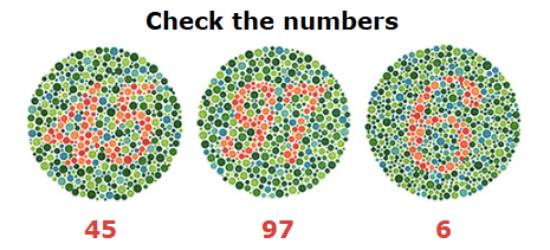
Human retinas have light sensitive cells called "cones" which allow us to see color. There are three kinds of cones in the human eye: red, green, and blue. People who are colorblind have mutations in their genes that cause a loss of either red or green cones. The result is that they have a hard time distinguishing between colors.
Most color perception defects are for red or green or both. Yellow-blue colorblindness is extremely rare.
Colorblindness primarily afflicts males. The genes for red and green cones are on the X chromosome and males have only one copy of this chromosome. Females, on the other hand, have a second X chromosome that serves as a backup if something goes wrong with the first. About one man in ten is colorblind.
|
|
|
|
|
|
|
|
|
|
|
|
|
METHODS FOR CONTROLLING YOUR EMOTIONS
|
|
| |
The purpose in providing some additional information on controlling your emotions is twofold: First, it is important for you to know that you are not a hostage of your emotions. You can control them. Second, there are scientifically proven ways of dealing with your emotions, so that you can manage your life and also to be a safe driver. Exhibiting self-control proves to the world that others cannot control your emotions. You are ultimately the one in control.
1. Controlled breathing. Direct control of your breathing can help to control your emotions. Research shows that when you are content and positive your "automatic pilot" causes your breathing to be deep, easy, and effortless. When you become emotional, your automatic pilot causes a change in breathing patterns.
When you are angry, afraid, or anxious you tend to over-breathe or hyper-ventilate. When you are sad, in suspense, or depressed you tend to under-breathe, or literally, hold your breath. Along with these automatic breathing patterns, a series of other physical changes is going on-chemical, glandular and neurophysiological-which heighten the emotional context. The origin of these physical changes is the preparation for fight-or-flight, all of which works against safe driving attributes.
Through controlling over-or under-breathing caused by negative emotions, you can ease your emotional state and restore calm and serenity. Here's how: Breathe in ten or more deep, smooth, and rhythmic breaths from your abdomen. With each exhale, hear a word such as "calm" or "peace" silently in your head. Direct control of your breathing triggers a calming response in your body, and within a short period of time your emotions will subside and you can regain control of your mental focus.
2. Control your thoughts and actions. Another way to exert control over your emotions is to believe that it is more important to control your thoughts and actions.
It is a long known fact that you cannot hold two thoughts equally in your mind. To release your negative thoughts, concentrate on any positive phrase or word that is encouraging or helpful to you and use it in a meditation exercise. Sit in a quiet place with your feet flat on the floor, hands loose in your lap, and eyes closed. Picture yourself sitting in an open field or by the ocean, or visualize any setting that is pleasant or peaceful to you.
Focus on the positive word or phrase that you wish to identify with, picture the words melting into a soft blue cloak or shawl and then
visualize
pulling the cloth around you in a deliberate act of comforting yourself. This type of meditation can take from 15 to 30 minutes and is effective in establishing an emotional 're-centering' that can have a longer lasting effect than other exercises.
Another method-autogenics-involves a physical relaxation exercise, concentrating on each part of the body and telling it to relax, and then actively imagining a feeling of coolness in the forehead.
It is important to note that (1) none of these exercises may be used while you are driving, and that (2) you should never get behind the wheel when you are emotional.
It is a waste of energy to focus on the negatives when you are driving. Keep calm and stay in control. The way you drive is a good indicator of who you are as a person. If you exhibit positive driving behaviors, other motorists will pick up on your attitude and also remain composed. The domino effect will then be reversed.
|
|
|
|
|
|
|
|
ROAD RAGE |
|
| |
The In The Driver's Seat 2008 AutoVantage Road Rage Survey
was conducted to determine the driving habits and attitudes of
commuters across the U.S. and to learn more about consumer views on the topic
of road rage.
"Unfortunately, road rage is too often a way of life," said Brad
Eggleston, vice president of AutoVantage. "More and more, in cities across
America, people are acting out their frustrations with dangerous results. And
with a gridlocked, fast-paced, multi-tasking society, the trend continues to
increase."
The survey revealed best and worst cities.
Least Courteous Cities (Worst Road Rage):
2008
1. Miami
2. Boston
3. New York
4. Baltimore
5. Washington, D.C
Most Courteous Cities (Least Road Rage):
2008
1. Pittsburgh
2. Portland, Ore.
3. Seattle
4. Minneapolis
5. Cleveland
|
|
|
|
|
|
|
|
A peace officer |
|
| |
A peace officer is a civil officer whose duty is to preserve public peace.
The California Penal Code currently limits "peace officer" status to certain law enforcement personnel. Examples of individuals who are designated peace officers includes: sheriffs, city police, district police, marshals, port police, investigators and inspectors employed by the office of a district attorney, California Highway Patrol officers, University of California Police officers, California State University Police officers, and San Francisco Bay Area Rapid Transit District police officers. (Cal. Penal Code §§ 830.1-830.55 (West 1999.))
|
|
|
|
|
|
New Smoking Law: |
|
| |
As of January 1, 2008, smoking in a vehicle with a minor present is prohibited. This is considered an infraction and is punishable by a fine of up to $100.
|
|
|
|
|
|
Pre-ride Inspection |
|
| |
Tires should have good tread and not be dried out and/or cracked. Check if tires are properly inflated.
Rims and spokes should be in good condition, tightly fastened to the motorcycle, and not cracked.
Check the brakes, clutch, and associated controls and cables. Adjust the brakes so that they completely stop the wheel from turning when fully applied.
Check for gas or oil leaks which can blow onto the back tire and cause a skid. Running out of gas at the wrong time, such as on a busy freeway, can be also very dangerous.
The chain should have about one inch of play and be properly lubricated.
The horn, headlights, and turn signals should all be checked too.
|
|
|
|
|
|
|
|
RESPONSIBILITIES OF THE PASSENGER |
|
| |
Insist on a proper fitting helmet. Remember: All operators and passengers must wear an approved safety helmet when riding on a motorcycle, motor-driven cycle, or motorized bicycle. It is the law. Don?t start the engine until the operator and passenger are both wearing their helmets.
If possible, follow guidelines on apparel. A heavy leather jacket, gloves, and leather boots that cover ankles are the best apparel for passengers on a motorcycle. These items will protect you in case of a collision and reduce the effect of wind.
Lean with the driver in turns. Passengers should know how to lean with the operator of the motorcycle during turns and curves. They have to stay directly behind the operator and lean as he/she leans.
Keep your feet on the passenger pegs at all times. This is a matter of staying safe and alive: Keep both feet on the pegs, even when stopped. Keep legs away from the muffler(s), chains, or moving parts.
|
|
|
|
|
|
|
|
A MINOR |
|
| |
People who are under 18 years of age considered minors. California Family Code 6500 defines ?minor? as ?an individual who is under 18 years of age.?
California Family Code
6500. A minor is an individual who is under 18 years of age. The
period of minority is calculated from the first minute of the day on which the individual is born to the same minute of the corresponding day completing the period of minority.
6501. An adult is an individual who is 18 years of age or older.
|
|
|
|
|
|
Classes of Licenses and Endorsement: |
|
| |
Commercial Class A
Restricted Class A Fire Fighter
Noncommercial Class A
Commercial Class B
Restricted Class B Fire Fighter
Noncommercial Class B
Basic Class C
Commercial Class C
Motorcycle Class M1
Motorcycle Class M2
Ambulance Driver Certificate
Verification of Transit Training Certificate
School Bus Endorsement
|
|
|
|
|
|
|
|
Resident |
|
| |
CA DMV:
Residency is established by voting in a California election, paying resident tuition, filing for a homeowner’s property tax exemption, or any other privilege or benefit not ordinarily extended to nonresidents.
CVC 516:
"Resident" means any person who manifests an intent to live or be located in this state on more than a temporary or transient basis.
Presence in the state for six months or more in any 12-month period gives rise to a rebuttable presumption of residency.
The following are evidence of residency for purposes of vehicle registration:
(a) Address where registered to vote.
(b) Location of employment or place of business.
(c) Payment of resident tuition at a public institution of higher education.
(d) Attendance of dependents at a primary or secondary school.
(e) Filing a homeowner's property tax exemption.
(f) Renting or leasing a home for use as a residence.
(g) Declaration of residency to obtain a license or any other privilege or benefit not ordinarily extended to a nonresident.
(h) Possession of a California driver's license.
(i) Other acts, occurrences, or events that indicate presence in the state is more than temporary or transient.
|
|
|
|
|
|
|
|
Education Requirements |
|
| |
If you are between the ages of 15 ½ and 17 ½, you must do one of the following:
- Complete drivers education and drivers training
- Finish drivers education and begin drivers training
- Be enrolled in a DMV-approved program that provides both drivers education and drivers training
|
|
|
|
|
|
Signing Form DL 44 |
|
| |
Parents/guardians and their minor have to sign this form.
Signing this form by a minor means compliance with the following statement: "I agree to submit to a chemical test of my blood, breath, or urine for the purpose of determining the alcohol or drug content of my blood when testing is required by a peace officer acting in accordance with Sections 13388 or 23612 of the Vehicle Code."
Signing this form by parents or guardians states that they accept financial responsibility for the minor who gets a drivers license.
|
|
|
|
|
|
|
|
A Safe Vehicle Requirements |
|
| |
According to the CA DMV, before your driving test starts, the examiner will checks the following:
- Two license plates (the rear plate must show current registration)
- Front and back turn signal lights and working brake lights
- A working horn designed for the vehicle
- Tires with no bald spots
- Adequate brake pressure (you will be asked to step on the brake pedal to see if it works properly)
- A driver’s side window that rolls down
- A windshield that allows a full unobstructed field of vision
- Two rear view mirrors (one must be on the outside, to the driver’s left)
- Driver and front passenger doors that open from both the inside and outside
- A secured glove compartment door so it doesn't open during the test
- A passenger seat permanently attached to the vehicle
- Working safety belts, if the vehicle was manufactured with safety belts
- Working emergency/parking brake
(Fast Facts DL 22 How to Prepare for Your Driving Test)
|
|
|
|
|
|
|
|
A Properly Insured Vehicle |
|
| |
You must show that your vehicle is properly insured before the driving test begins (or the test will be postponed) by providing one of the following:
- A document with the liability insurance policy or surety bond number
- An Assigned Risk insurance card with the name of the assigned insurance company, file number, and current coverage dates
- Current insurance binder or copy of an insurance policy signed or countersigned by an insurance company representative
- Rental car contract if the driver is listed on the contract as the insured
- DMV-issued certificate of self-insurance or acknowledgment of cash deposit
- Written confirmation from the insurer that the person is insured
(Fast Facts DL 22 How to Prepare for Your Driving Test)
|
|
|
|
|
|
|
|
Safe Driving Tips |
|
| |
Practice these tips to improve your driving skills:
- Steer smoothly at all times.
- Accelerate smoothly. Don't race the engine or make it stall.
- Stop the vehicle gently. Start braking well ahead of where you must stop to avoid sudden “jerks.” Know where to stop. Be aware of crosswalks. If your view is blocked at a crosswalk, move forward carefully and look both ways before entering the intersection.
- Be sure your vehicle is in the correct gear. Don't grind the gears. Don't coast to a stop.
- Always obey the posted speed limits. If needed, reduce your speed to adjust for existing weather, road, and other traffic conditions. Remember to turn on your lights if you need to use your windshield wipers in poor weather conditions.
- Follow at a safe distance. Use the three-second rule. Increase your following distance in bad weather or poor visibility.
- Know what the traffic signals mean and obey them at all times.
- Always use the proper lane. Turn from the correct lane into the correct lane.
- Signal for all lane changes and turns.
- Always look for potential hazards (scan). Check your mirrors frequently. Always look over the proper shoulder before making lane changes or pulling away from the curb.
- Drive defensively. Anticipate another driver’s errors.
Safe Driver Checklist
Starting the Vehicle:
- Adjusts mirrors
- Fastens safety belt
- Knows where the operating controls are located
Moving Forward:
- Signals
- Looks in mirrors and over shoulder before pulling into traffic.
- Uses two hands on opposite sides of the steering wheel.
Stopping:
- Checks traffic (sees and reacts to hazards).
- Stops behind crosswalk or limit line.
- Stops without using accelerator at the same time.
Turns:
- Slows for turns.
- Begins and ends turns in the correct lane.
- Yields right of way when necessary.
- Accepts legal right of way when safe.
- Sees and reacts to hazards.
Backing:
- Checks mirrors and looks over right shoulder.
Changing Lanes:
- Signals
- Checks mirrors.
- Checks over shoulder to view blind spot.
- Changes lanes safely.
- Maintains speed.
Driving On The Freeway:
- Checks traffic flow.
- Times entry into freeway.
- Checks mirrors and over shoulder before merging into traffic.
- Signals early and slows on exit ramp.
- Adjusts speed to road conditions.
Defensive Driving Techniques:
- Checks mirrors before braking.
- Checks cross streets before passing.
- Checks signal lights and signs.
- Keeps eyes "moving".
- Keeps a "space cushion" around the car.
- Follows at a safe distance.
Other Test Information
For your safety, please ask the examiner to show you his or her DMV identification badge before the test begins. Pets or passengers, other than the examiner or other authorized personnel, are not permitted during your driving test.
If you have any questions, you may ask the examiner before your driving test begins. During the test, the examiner will ask you questions or give you directions, but he or she will not engage in general conversation.
(Fast Facts DL 22 How to Prepare for Your Driving Test)
|
|
|
|
|
|
|
|
DURING THE DRIVING TEST |
|
| |
The examiner will note:
- How you start your vehicle. When leaving the curb, do you use your mirrors and turn your head and look back for passing cars? Do you signal and wait until it is safe before entering traffic?
- How you control your vehicle. Do you use the accelerator, brake, steering wheel, and other controls correctly?
- How you drive in traffic. Do you use the proper lane? Do you signal, change lanes carefully, and follow other vehicles at a safe distance? Do you turn your head and look back before pulling away from the curb or changing lanes? Do you signal the proper distance before turning?
- How you obey the traffic signals and posted signs.
- How you drive through blind or crowded intersections. Do you scan carefully for signs, signals, pedestrians, and other vehicles? Do you yield and take the right-of-way correctly?
- How you steer your vehicle. Do you turn from the proper lane into the proper lane? Is your turn too wide or too sharp?
- How you stop. Do you stop smoothly and at the correct spot? Can you stop quickly and safely in an emergency? In a vehicle with a manual transmission, do you keep the vehicle in gear or push the clutch in and coast to a stop?
- How you back up. Do you look over your right shoulder? Can you back in a straight line? Do you have complete control of the car?
- How you change your speed to suit the number and speed of cars nearby, the people crossing the street, road conditions, weather, the amount of light, and the distance you can see ahead.
- How you judge distance. Do you stay a safe distance away from other cars when following or passing? Do you stay a safe distance away from people walking or riding on the road?
- How you respect the rights of others. Are you courteous to other drivers and pedestrians?
- Whether you pay full attention to the driving environment.
|
|
|
|
|
|
|
|
STEADY |
|
| |
Steady (Steady Mode)?the continuous illumination of a traffic signal for the duration of an interval, signal phase, or consecutive signal phases.
|
|
|
|
|
|
FLASHING |
|
| |
Flashing—an operation in which a highway traffic signal indication is turned on and off repetitively.
|
|
|
|
|
|
TRUE FULL NAME |
|
| |
Your true full name appears on your birth date/legal presence document.
When your name on your birth date/legal presence document is different from your recent name, you must provide one of the following documents:
- Adoption documents that contain the legal name as a result of the adoption
- A name change document that contains the legal name both before and after the name change
- Marriage certificate (issued from a local or state office of vital statistics).
- Dissolution of marriage/domestic partnership document that contains the legal name as a result of the court action.
- A certificate, declaration, or registration document verifying the formation of a domestic partnership.
|
|
|
|
|
|
|
|
Examples of Acceptable Birth Date/Legal Presence Documents
|
|
| |
- US Birth Certificate or U. S. Passport
- US Certificate or Report of Birth Abroad
- Federal Proof of Indian Blood Degree
- American Indian Card (I-551)
- Birth Certificate or passport issued from a US territory
U.S.
- Citizen Identification Card
- U.S. Military Identification Cards
- Common Access Card (only if designated as Active Military or Active Reserve or Active Selected Reserve)
- Certificate of Naturalization or Citizenship
- Temporary Resident Identification Card
|
|
|
|
|
|
|
|
EMANCIPATED MINORS |
|
| |
Emancipation is a legal way for children to become adults before they turn eighteen. Under California Emancipation of Minors law, minors may be emancipated if they fulfill one of these three categories:
- The minor has gotten married with permission from parents and the court.
- The minor has joined the armed forces with permission from parents.
- The minor has received a declaration of emancipation from a judge.
California law states in order to get a declaration of emancipation from a judge, the minor has to prove ALL of the following criteria:
- The minor must be at least 14 years old.
- The minor must not want live with their parents and the parents do not mind if the minor moves out.
- The minor can handle their own money.
- The minor is employed and has a legal way to make money.
Once a minor is emancipated, his or her parents don't have custody or control of him or her anymore and he or she can do some things without parental permission, including: get medical care, apply for a work permit, and sign up for school or college.
However, an emancipated minor must go to school, must get parental permission before getting married, and will go to juvenile court if he or she breaks the law.
|
|
|
|
|
|
|
|
LIMIT LINE |
|
| |
A limit line is a solid white line not less than 12 nor more than 24 inches wide, extending across a roadway or any portion thereof to indicate the point at which traffic is required to stop in compliance with legal requirements (CVC 377).
|
|
|
|
|
|
ALLEY |
|
| |
"Alley" is any highway having a roadway not exceeding 25 ft in width which is primarily used for access to the rear or side entrances of buildings.
|
|
|
|
|
| |
For example: Alabama, Alaska, Arizona, Arkansas, Nevada, Colorado, Connecticut, Delaware, Florida, and North Carolina
|
|
|
|
|
|
VEHICLE THEFT PREVENTION SUGGESTIONS |
|
| |
Here are suggestions from Calofornia DMV to prevent vehicle theft:
- Install a mechanical device that locks the steering wheel, column, or brakes.
- Investigate the purchase of a vehicle theft tracking/security system, especially if you own one of the frequently-stolen model vehicles.
- When you must leave your key with a valet, attendant, or mechanic, only leave the ignition key.
- Copy your license plate and vehicle information on a card, and keep that information with you. The police will need this information, if your vehicle is stolen.
|
|
|
|
|
|
|
|
BICYCLE LIGHTS AND REFLECTORS REQUIREMENTS |
|
| |
When riding at night bicyclists must use lights and reflectors specified by CVC 21201 as follows:
- A lamp emitting a white light that is visible from a distance of 300 ft in front and from the sides of the bicycle.
- A red reflector on the rear that shall be visible from a distance of 500 ft.
- A white or yellow reflector on each pedal, shoe, or ankle visible from the front and rear of the bicycle from a distance of 200 ft.
- A white or yellow reflector on each side forward of the center of the bicycle, and a white or red reflector on each side to the rear of the center of the bicycle (except bicycles that are equipped with reflectorized tires at the front and the rear).
|
|
|
|
|
|
|
|
CONSTRUCTION OF THE AUTOMOBILE |
|
| |
AUTOMOBILE FRAME
The frame is the most important part of any vehicle. It provides a firm structure for the body and a solid anchor point for the suspension system. Frames are made to be rigid, keeping all the other parts of the car in alignment.
AUTOMOBILE BODY
The body shell of your car is made of several large steel sections, which are designed to protect the occupants from potential collisions and outside elements. It also provides solid mounts for all other systems and allows the car to travel with minimal air resistance.
ENGINE
The engine produces the drive power that moves a vehicle forward or backward.
There are many engine configurations available in today’s market. The most common are 4-cylinder, 6-cylinder, and 8-cylinder engines—the amount of cylinders a car has corresponds to the power of the engine and how smoothly it drives
.
STEERING SYSTEM
A vehicle’s steering system is made of a steering wheel, gears, linkages, and other components.
Together these parts control the direction of the vehicle’s movement.
SUSPENSION SYSTEM
A car’s frame, body, and engine are suspended above the wheels by a system of springs. This spring system (called the suspension) lessens the jarring caused by road irregularities. The suspension must also keep the wheels in close contact with the road surface at all times.
ELECTRICAL SYSTEM
Electricity is distributed throughout your vehicle by various electrical circuits, which power your lighting system, electrical motors, and vehicle computer system. It also powers your radio and the car’s interior cooling, heating, and ventilating system.
Battery:
The battery is your vehicle's primary source of electrical power. When the ignition switch is turned, the power from the battery activates the starter motor. This sparks the engine and brings the vehicle to life.
Alternator:
The alternator generates power for the vehicle systems and charges the battery while your vehicle’s engine is running.
FUEL SYSTEM
Your vehicle’s fuel system delivers gasoline and air to the engine.
Gas is stored in the fuel tank, which is usually located near the rear wheels of the vehicle. The fuel pump draws gas from the fuel tank through the fuel line and filter to the carburetor or fuel injector. Once drawn, the gas is delivered to the cylinder chamber for combustion.
Fuel Pump:
The fuel pump has three functions. Its first task is to deliver fuel to the engine. Next, it keeps the fuel from boiling by maintaining the pressure in the fuel line and prevents vapor lock.
Fuel Filter:
There are many small jets and passages in a carburetor and fuel injector openings that need to stay clean so your engine can function properly. To ensure cleanliness, fuel filters are installed in the fuel line.
Carburetor:
The carburetor blends the mixture of fuel vapor and air in an internal-combustion engine and sends this mixture to your engine's cylinders.
Fuel Injector:
Most modern cars have fuel injectors instead of carburetors.
The fuel injector is supplied with pressurized fuel by a pump. When the injector is energized, an electromagnet moves a plunger that opens the valve, allowing the pressurized fuel to be released through a tiny nozzle.
Intake Manifold:
An intake manifold is a system of passages which move the fuel mixture from the carburetor to the intake valves of the engine. Manifold design helps the engine operate efficiently.
COOLING SYSTEM
Heat is created by the friction of moving engine parts and the explosion of gasoline in the cylinders. This heat is then removed through the vehicle's cooling system.
Heat is absorbed by a coolant (a chemical solution) flowing through passages inside the engine. This coolant protects the cooling system from corrosion, lubricates the water pump, and prevents freezing. A water pump circulates the coolant through hoses in the cooling system while the engine is running.
Radiator:
The radiator, which stores the coolant, is responsible for reducing heat in the coolant. The radiator is cooled by the radiator fans and air currents when the vehicle is in motion.
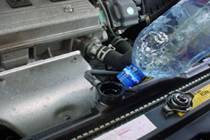
The flow of coolant is controlled by the thermostat, a heat-sensing valve which allows your engine to quickly heat up to proper running temperature.
BRAKE SYSTEM
There are two types of regular brakes used to slow your car while driving: disc and drum brakes. Both types use friction to slow the wheels.
Disc Brakes:
In disc brakes, a piston causes the brake shoes (pads) to grip a spinning disc and slow the wheel via friction.
Drum Brakes:
Like the disc brake, the drum brake has two brake shoes and a piston. When you hit the brake pedal, the piston pushes the brake shoes against the drum.
Brake Fluid:
Brake fluid is a special liquid used in the brake hydraulic system.
Brake fluid transmits force to various parts of the braking system when you step on the brake pedal.
|
|
|
|
|
|
|
|
HEADLIGHTS |
|
| |
There must be two headlights at the front of your vehicles, one on each side above the front axel, between 54 inches and 22 inches from the ground. These lights must be visible in the darkness (CVC 24400).
|
|
|
|
|
|
TIRE INFLATION |
|
| |
Properly inflated tires are critical to vehicle control and good gas mileage. Under-inflated tires flex too much and build up heat, which can lead to blowouts or the tread separating and peeling off. Tires should be inflated to the vehicle manufacturer's recommended pressure as listed in the owner's manual (it may also be found on the driver's side car door or in the glove compartment). Recommended tire pressures are for cold tires.
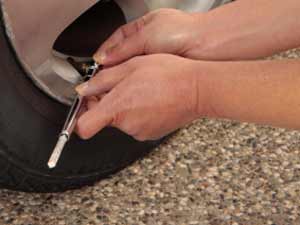 |
Check your tire pressure at least once a month with a tire gauge. Tire gauges are available at most auto parts stores and come in three types: pen, digital, and dial. Dial gauges are considered easier to read than pen or stick designs. |
|
|
|
|
|
|
|
|
|
TURNS ON RED |
|
| |
A right turn can be made against a red light after you come to a complete stop and yield to pedestrians and vehicles in your path. Do not turn if there is a NO TURN ON RED sign.
You also may turn left against a red light from a one-way street onto another one-way street where traffic moves left if there is no sign that prohibits the turn. Signal and stop for a red traffic light at the limit line, if there is one, or before entering the intersection. Turn only after you yield to pedestrians and vehicles in your path. |
|
|
|
|
|
|
|
MOTORCYCLES EQUIPMENT |
|
| |
Every motorcycle should be equipped with one headlamp projecting sufficient light within a distance of 115 ft.
Make it a habit to conduct a pre-ride inspection of following:
- Tires
- Rims and spokes
- Brakes, clutch, and associated controls and cables
- Gas or oil leaks
- Chain
- Horn, headlight, and turn signals
Tires should have good tread and not be dried out and/or cracked. Check if tires are properly inflated. Rims and spokes should be in good condition, tightly fastened to the motorcycle, and not cracked. Check the brakes, clutch, and associated controls and cables. Adjust the brakes so that they completely stop the wheel from turning when fully applied.
Check for gas or oil leaks which can blow onto the back tire and cause a skid. Running out of gas at the wrong time, such as on a busy freeway, can be also very dangerous.
The chain should have about one inch of play and be properly lubricated.
The horn, headlights, and turn signals should all be checked too.
|
|
|
|
|
|
|
|
RIDE DEFENSIVELY
|
|
| |
The rules of defensive driving:
- Don?t assume that you?ll be seen.
- Help others to see you by choosing an appropriate lane position.
- Never drive in the blind spots of another driver.
These are universal rules for any road user, but for motorcyclists they are especially important because motorcycles are smaller than other vehicles. Driving alongside a car or a truck is dangerous, avoid it whenever possible.
There are also additional rules specific to motorcycles that can make for a safer and more pleasant experience.
Be aware of the road surface at all times, especially when cornering. It is crucial for motorcyclists to pay attention to changes on a road surface while riding straight ahead, but cornering is especially dangerous and requires even more attention to the road surface. Each irregularity or spot on the road should be treated with caution and avoided if possible. It could be oil or water, each of which can cause a skid.
Use the front and rear brakes for everything but leisurely stops. Motorcyclists should never suddenly hit the brakes. Too much pressure on the front brake may lock the front wheel and the motorcyclist will end up thrown over the handlebars.
When in traffic, follow the path of left rear wheel of the car ahead.
Why is this a good idea? This position increases your visibility by making the motorcycle visible in the rearview mirror of the driver being followed. It is also a good idea to cross intersections along with other traffic. This can prevent you from being hit. A driver who might not see a motorcycle will see other vehicles.
|
|
|
|
|
|
|
|
RIDING APPAREL |
|
| |
When you are riding a motorcycle, wear proper, lightly colored riding apparel, including a, heavy jacket (preferably leather), gloves, and leather boots that cover your ankles.
|
|
|
|
|
|
DIVIDED HIGHWAYS |
|
| |
Divided highways are highways divided into two or more roadways−by barriers or a dividing section (of not less than two feet in width), either unpaved or delineated by curbs, double-parallel lines, or other markings−to separate traffic moving in opposite directions.
CVC 21651
|
|
|
|
|